
How can innovative tools and scientific knowledge support more sustainable and climate-resilient forest management across the Mediterranean?
This question was at the heart of the StrategyMedFor technical webinar “Transferring Tools to Forest Managers”, held online on 3 November 2026. Bringing together more than 40 participants from 17 institutions and 13 countries, the public session presented the project’s Forward-looking Framework for Sustainable Forest Management in the Mediterranean Region and explored how its indicators, spatial datasets and practical tools can support decision-making in different territorial contexts.
Through technical presentations, pilot-site experiences and exchanges with participants, the webinar highlighted an important message: tools are most useful when they respond to local needs, are validated with field knowledge and can be integrated into existing forest management practices.
A common framework for Mediterranean forest management
The webinar opened with a presentation of the StrategyMedFor Framework, which builds on the six Forest Europe criteria and incorporates 11 supplementary indicators addressing specific Mediterranean forest challenges, including biodiversity, climate change, forest fires and ecosystem services.
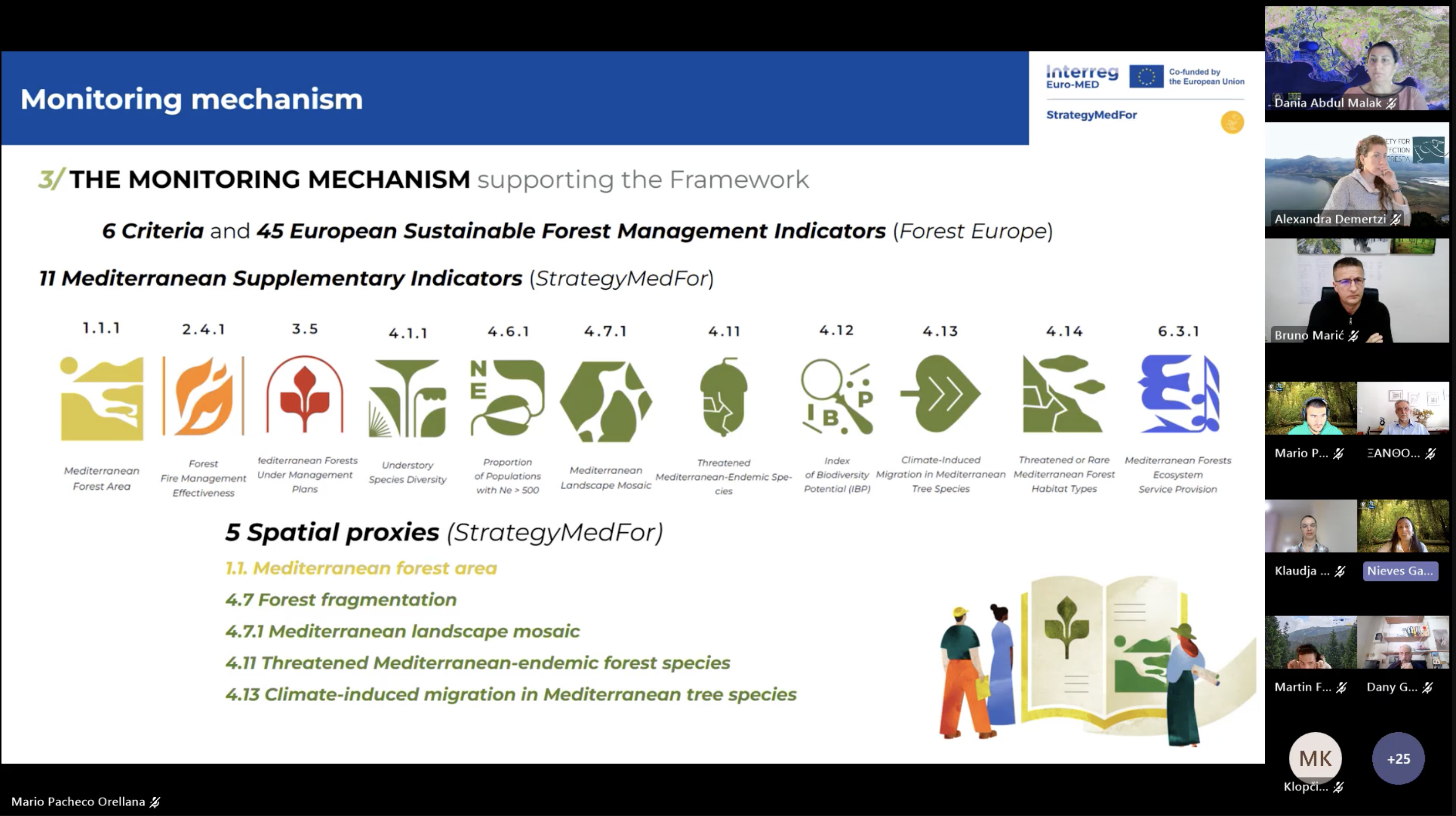
Discussions highlighted the potential of these indicators to complement existing national monitoring and reporting systems. However, their effective application requires flexibility to reflect local ecological and socioeconomic conditions, as well as consistent data collection to enable comparisons between territories. Participants also stressed the importance of training and institutional engagement, particularly in countries where these indicators are not yet routinely used.
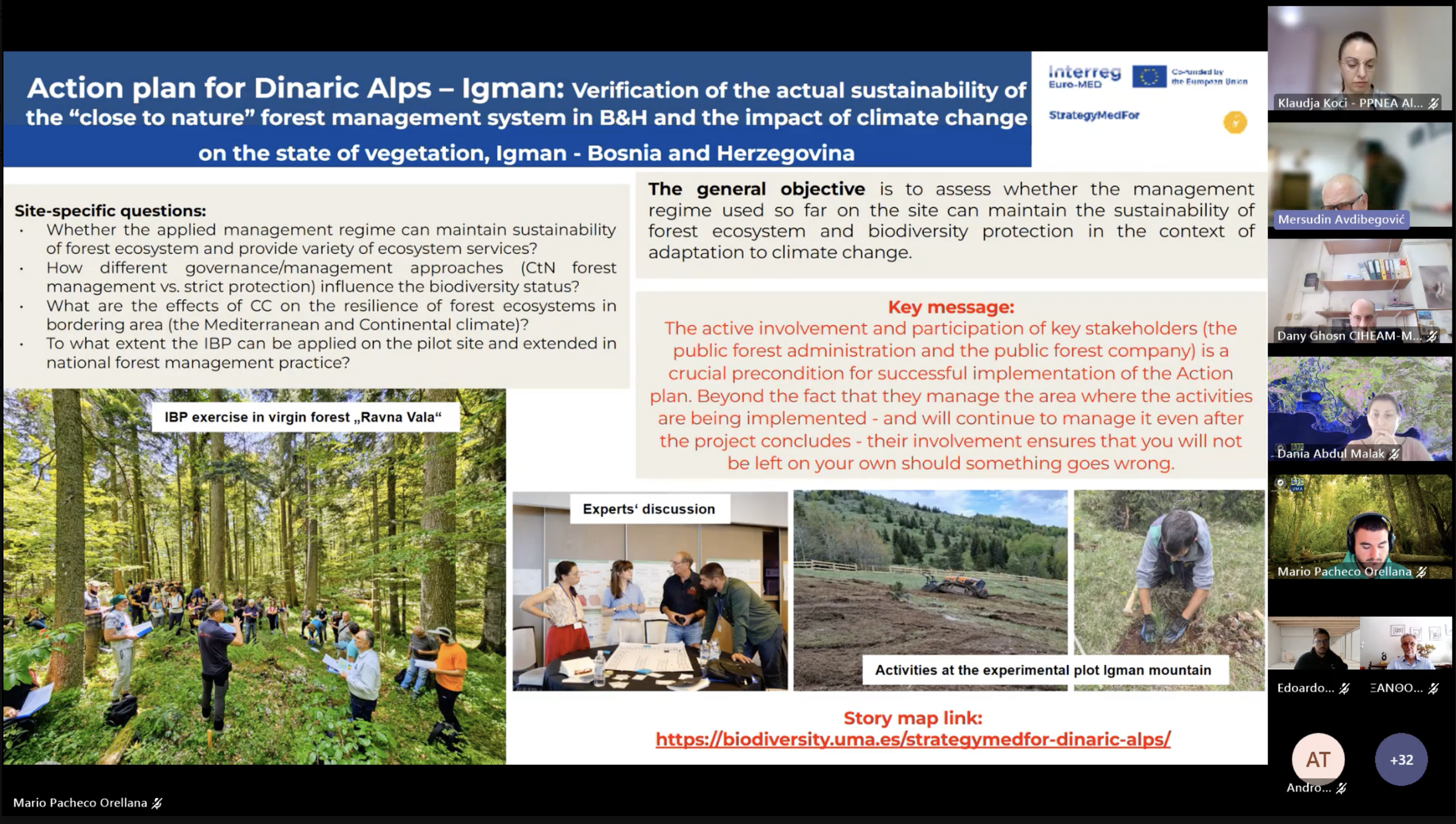
Site-level experiences tested in the Dinaric Alps demonstrated the importance of checking spatial indicators and thematic maps against local information, field observations and expert knowledge. This process of validation helps ensure that spatial products are reliable and relevant to actual management conditions.
Practical tools to address key forest management challenges
Several StrategyMedFor tools were presented, illustrating how scientific information and spatial analysis can support concrete management decisions.
- Biodiversity assessment: The High Ecological Value Forest tool helps identify areas of particular ecological significance, while the Index of Biodiversity Potential (IBP) provides a rapid, field-based assessment of a forest stand’s capacity to support biodiversity. The Igman pilot-site experience demonstrated its applicability in both virgin and regularly managed forests. Participants highlighted its potential integration into routine forest management, and interest was expressed in testing the tool in Slovenia.
- Forest fire impact assessment: The Forest Fire Impact Score helps identify areas affected by repeated or significant fire impacts and supports the prioritisation of prevention, rehabilitation and restoration measures. The discussion highlighted opportunities to transfer the tool to Albania and other Western Balkan territories, as well as the added value of combining fire impact information with biodiversity and ecological connectivity data.
- Climate-resilient restoration: Species Distribution Models provide insights into how the suitable habitats of Mediterranean tree species may change under future climate scenarios. Experiences from the Igman pilot site illustrated how modelling can inform long-term forest management, species selection and restoration planning. Participants emphasised that model outputs should be treated as decision-support information rather than precise predictions, and should be interpreted alongside local knowledge and field evidence.
- Prioritising management actions: The StrategyMedFor decision-making tool brings together spatial indicators and assessments to help identify areas where protection, restoration or resilience-oriented interventions should be prioritised. Its application in the three pilot territories showed how different ecological conditions call for different management responses. Participants also highlighted its potential to make existing action plans more specific and evidence-based.
Local adaptation and institutional cooperation are essential
Following the technical presentations, the discussions generated important lessons about the conditions needed for successful transfer.
First, tools cannot simply be transferred from one territory to another without adaptation. Differences in ecological conditions, data availability, forest management systems and governance arrangements must be taken into account. Local validation and the involvement of practitioners are essential to ensure that methodologies are relevant and usable.
Second, successful implementation depends on cooperation with the institutions responsible for forest management. Public forest administrations, forest companies, protected-area authorities, research organisations and local stakeholders all have a role to play. Integrating new approaches into existing forest management plans and institutional frameworks is more effective than creating parallel processes.
The experience of the Prespa–Ohrid Action Plan also demonstrated both the value and the challenges of transboundary cooperation. Shared ecosystems require coordinated approaches, but administrative procedures, institutional hierarchies and the commitment of public authorities can influence the implementation of joint actions. Technical working groups and sustained relationships between practitioners can provide a starting point for stronger cooperation across borders.
From the webinar to the next steps of the Transfer phase
The webinar marked an important milestone in StrategyMedFor’s Transfer phase, which focuses on adapting and applying the project’s tools and knowledge in additional territories.
The next activities will build on the discussions and interests expressed during the webinar. Receiving partners and associated partners will identify the tools most relevant to their territories through a needs assessment process. This will guide tool adaptation, knowledge-exchange visits and tailored capacity-building activities.
A practical training workshop is planned in Sarajevo between late May and early June 2027. Further work will also focus on biodiversity assessment, forest fire impact evaluation, climate-resilient restoration and the development of transboundary cooperation mechanisms in the Dinaric Alps.
The tools and methodologies presented during the webinar will be brought together in an action-oriented toolbox accessible through the Mediterranean Biodiversity Protection Knowledge Platform.
The main lesson from the webinar is clear: transferring knowledge is not about applying a standard solution everywhere. It is about adapting sound scientific tools to local realities, strengthening the capacities of the institutions that will use them, and turning shared knowledge into better-informed forest management decisions.